Impart Resources

Impart Product Update - Nov 2025
We’ve delivered a major round of upgrades across the Impart platform, introducing new AI Bot/MCP and LLM Protection dashboards, a refreshed and more intuitive App Experience, a high-performance Inspector v0.42.0 release, expanded Inspector Metrics for deeper operational visibility, and new SQLi and XSS version control, allowing teams to choose between Detection Version 1, Version 2, or always use the latest release. These updates make it easier than ever to understand AI-driven traffic, configure protections with clarity, manage detection behavior with precision, monitor system performance, and optimize your entire Impart deployment.

.png)
Beyond The Prompt: Constraining The Blast Radius Is The Only Way To Secure AI Agents
Prompt sanitization addresses the input layer. Active runtime enforcement addresses the execution layer. For AI agents with access to private data and external channels, only one of those stops a successful attack.

.avif)
Filters
Beyond The Prompt: Constraining The Blast Radius Is The Only Way To Secure AI Agents
Prompt sanitization addresses the input layer. Active runtime enforcement addresses the execution layer. For AI agents with access to private data and external channels, only one of those stops a successful attack.


The LLM API Endpoint Is Your New Perimeter. Protect It Like One.
Security engineering teams have spent years hardening application APIs. Auth tokens, rate limits, input validation; the fundamentals are well understood. But when you place an LLM behind that same API surface, the threat model changes in ways standard application security controls weren't built to handle. The endpoint doesn't just serve data anymore. It executes intent.
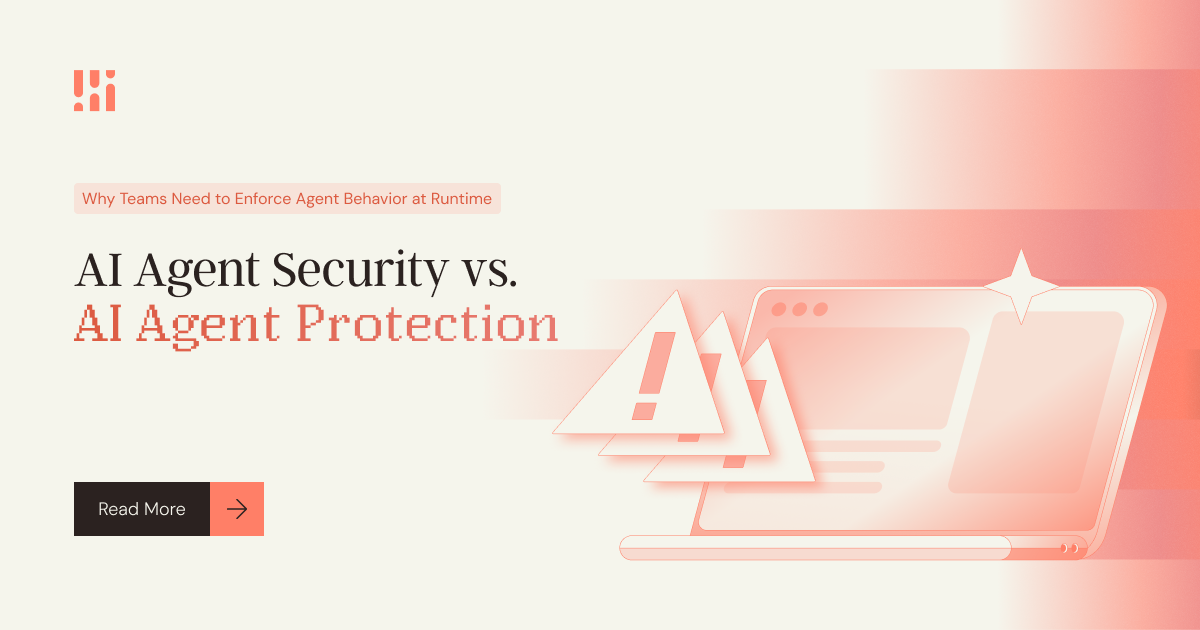
AI Agent Security vs. AI Agent Protection
The AI security market is moving fast to respond to predictions that over 40% of enterprise applications will have embedded AI agents by the end of 2026. Every vendor is packaging their answer under the label "AI agent security." The problem is that "AI agent security" means something different depending on who's selling it. This post defines what each layer does, where each one runs out of road, and why the architecture needs both.
LLM Security vs. LLM Protection
LLM security and LLM protection get used as synonyms across vendor briefings and CISO conversations. They describe fundamentally different capabilities. This post breaks down what each layer actually covers, where each earns its place in a production LLM defense architecture, and where each leaves teams exposed when an attack executes.

MCP Surface Mapping: Know What You're Protecting
Model Context Protocol servers don't register themselves, and that gap creates real risk. Before security teams can write rules, enforce authorization policy, or establish behavioral baselines, they need to know what's running. This post breaks down how to build the inventory, manifest, and ownership model that makes enforcement possible.
MCP Security vs. MCP Protection
MCP security and MCP protection are used almost interchangeably, but they describe fundamentally different approaches. One vendor means access control and authentication. Another means runtime threat detection. Both call it MCP security. This post breaks down the differences, where the real value is, and where the gaps are that neither fully closes on its own.
.avif)


.png)